I receive e-mails with questions like these on a regular basis, so I’ll give my $.02 on the following topics:
1. “How many MCQs should I do…”
2. “What was your overall strategy for FAR and REG since you passed them most recently?”
3. “I’m seeing MCQs not specifically mentioned in my lectures, should I be worried?…”
***
Question 1: “How many MCQs should I do…”
In short, as many as you can…but you already knew that. I’ll get more specific in question 2.
***
Question 2: “What was your overall strategy for FAR and REG since you passed them most recently?”
I realize that not everyone who reads this site uses the same study materials that I did (but if you aren’t passing with your current materials – you need to buy Yaeger HomeStudy if you scored a 69 or below previously, or Yaeger’s Cram DVD for previous scores of 70-74 – use it, pass, and move on with your life…), but it’s what I used for my final attempts at FAR, REG, and BEC.
I passed BEC using the Yaeger Cram DVD, so for purposes of overall exam strategy from start to finish, I’ll use REG and FAR as an example since I used their HomeStudy course.
The material for FAR and REG are voluminous – especially FAR. The people who take the approach of just buying a book and studying without video lectures are crazy in my opinion, but more power to them. It’s like trying to find a downtown restaurant in a big city you’ve never visited before using a roadmap when GPS is readily available.
FAR has so much material that even whittled down to the stuff you “must know” – the Yaeger FAR video set is still 13 DVDs. So – make sure you are using great materials that are up to date.
Once you have your materials in place and you’re ready to go – this is what I would do (again, using Yaeger as an example)…
1. Watch the videos, but don’t read the book.
This probably doesn’t go for all review courses, but it does go for Yaeger: if you watch the DVD lectures – you don’t need to read the book. Do you need the book? Absolutely. You don’t have to read the book, but you do have to follow along with the instructor page by page and mentally absorb what they’re saying.
Personally – I hate reading textbooks – one of the reasons why Yaeger “clicked” with me.
2. Take INSANE notes
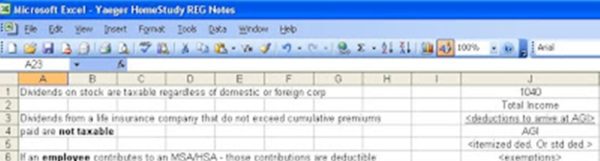
Highlighting in a book doesn’t work for me. For one – highlighting requires coming back to that particular page in the future in order for highlighting to do any good (and when your book is a monster like FAR ~ revisiting every page is a chore). Two – you’re highlighting text that is written in GAAP-ese…it means nothing to you. You need to take the particular fact sequence in question and make it your own so that you understand it and write it in such a way that you will understand it 5 weeks from now when you’re doing your final exam review.
Is it a chore? Yes.
Will you start to gag as you pull your third legal pad from the pack and you’re only on DVD 3 out of 13? Yes.
Will it pay off in the end? Yes.
An added benefit of doing this is that CPA review material, which is very boring by nature, will not seem as boring because you’re actively learning – you’re participating while you learn – you’re “doing” instead of mindlessly staring at the screen wishing you were watching something from Netflix instead of a CPA review course.
I was never a big note taker until I realized that it helps to pass the time much quicker. It makes you feel like you’re “happening” to the material instead of it happening to you while you furiously try to keep up with the lecturer. By the way – it’s ok to hit “pause”. I probably halved the useful life of my space bar by hitting it to pause the video as I took notes.
3. Save all MCQs until you’re finished with all of your lectures.
Take this one with a grain of salt. If you’re a Phil Yaeger student – this goes against what he teaches you to do. He’s an expert on the exam – and his way is the “best” way because the more MCQs you do over the course of studying – the better you will be. He tells you to work the assigned MCQs after each Module in Wiley. For me, it was a motivation thing. I felt that as long as I had a mountain of DVD lectures ahead of me, I lost motivation to study. SO ~ my solution was to charge ahead full steam and finish the DVDs as quickly as possible (but still take insane notes)
What worked for me was to wait until I had finished all 13 DVDs (using FAR as an example) and then work the MCQs starting from the first Module. For one, it’s the motivation thing as I mentioned and second, you’re going to have to do them again anyway after you finish the lectures, and I didn’t want to do them twice.
Again – Phil Yaeger is the guy with the CPA, PhD, etc. I’m the guy who sat for the exam 14 times…so take this with a grain of salt. Phil is the driver’s ed instructor telling you to keep your hands at “10 and 2″. I’m the stupid guy driving down the interstate going 80 mph eating a McDonald’s value meal, talking on the phone, and adjusting my iPod all the while steering with my knee. Both methods will get you there…but one is much riskier than the other.
4. Take INSANE notes over the MCQs
Yaeger has a list of “minimum” questions to do in the Wiley book and if you’re a Yaeger student – don’t even think about heading to the exam without doing all of them. They hand-picked this list that gives you your biggest bang for your buck. It’s an “if you do nothing else – do THESE” sort of thing.
As you work the Yaeger-assigned MCQs – take excellent notes over every question that you either miss (do the question and flip to the answer…or just tear out the answers and staple them together)…or think you might forget. This is key: it isn’t what you can answer in week one – it’s what you can answer in week 5,6,8…whatever week you sit for the exam.
If you think you might forget that financial capital maintenance concepts are GAAP, but physical capital maintenance concepts are not GAAP – WRITE IT DOWN.
After you work your assigned “minimum” MCQs, work mini twenty question testlets over each topic using your practice software. After you’re done, if you’re still not sure about which accounting changes are treated prospectively vs restatement, work a 20 question testlet over the topic doing random questions assigned by the software. Again – take notes.
5. Take a week and re-write your notes
It sounds crazy, and it does take a lot of time, but it WILL pay off. I did this for REG (92). I did not do this for FAR (76). You be the judge. Also – as you re-write your notes, there will be things that you wrote initially as you furiously scribbled away that you don’t find relevant for your final review, or is a redundant item. If you take the time to do this, the end result will be a comprehensive set of final review materials that are written in a way that you understand and are devoid of any excess or non-essentials. Also – you will absorb the material better by re-writing it than you would merely reading it again.
6. Review
I recommend spending the day before your exam doing nothing but reading your final exam review notes. I wouldn’t do questions…you’ve already done hundreds (thousands?) of them by now. Try to read through your notes at least three times. If you’ve done it right, you have an impressive stack of notes and the material is dense. It could take the better part of a day to do this, so consider taking the day off of work. I would also read through them one more time 1-2 hours before your exam on exam day.
7. PASS
***
Question 3: “I’m seeing MCQs not specifically mentioned in my lectures, should I be worried?…”
No, you should not be worried…just realize that working exam problems is part of your review course. Your instructors simply cannot cover every topic and every angle of a topic. Their goal is to cover the material in-depth enough to where you can score a 75.
No one knows exactly what will be on the exam, but your instructors should have a good idea of what will be on it and put you in a position to win with a combination of what they teach on the lectures and the questions that they assign.
The lectures give you the foundation. The questions give you the application. Another reason why I liked Yaeger so much was the hundreds of MCQs that they work as they lecture over a topic. They teach a concept for 3-4 minutes and then work three or four MCQs to reinforce what they just taught. It’s the best of both worlds.
Good luck everyone.
Continue Reading
Get Social